


Start USAEBO with concepts, graphs and short explanations. Registration closes 27 February 2027, 11:59 p.m. U.S. Eastern Time.

1. Locate the learning gap before choosing your starting point
When preparing for USAEBO for the first time, identify the exact step where understanding stops. One student may not recognise a term; another may know its definition but struggle to draw a graph; a third may calculate correctly without explaining the result. These difficulties require different practice. Calling all of them a weak foundation can lead to copying a textbook from the beginning without addressing the actual problem.
Use one 45-minute study session for an initial diagnosis. Read the three areas of the official syllabus, choose a familiar topic in each, and write a definition, an everyday example and a condition the explanation requires. Mark unfamiliar items rather than trying to learn everything that day. The 45-minute session is a personal study suggestion, rather than a contest test or selection requirement.
The syllabus covers microeconomics, macroeconomics, and business and finance. Begin by making the connections below, then work through the full syllabus, including consumer choice, firms, market structures and international economics. This starting table is not a complete list of tested topics.
| Area | Starting task | Evidence of understanding |
|---|---|---|
| Microeconomics | Distinguish demand from quantity demanded | Label the axes and explain whether a curve shifts |
| Macroeconomics | Distinguish nominal from real measures | Separate changes in quantities from changes in prices |
| Business and finance | Separate returns, risk and cash flows | Calculate amounts and state the interest period and assumptions |
2. Connect reading, calculation and explanation in one supply-and-demand model
Consider this original practice example: quantity demanded is Qd = 100 − 2P and quantity supplied is Qs = 20 + 2P, where P denotes price and Q denotes quantity. Restrict attention to non-negative prices and quantities. Write the equilibrium condition Qd = Qs, then solve 100 − 2P = 20 + 2P to obtain P = 20 and Q = 60. Substitute back into both equations to confirm that each side gives 60.
The diagram places quantity on the horizontal axis and price on the vertical axis. The downward-sloping demand curve meets the upward-sloping supply curve at quantity 60 and price 20. Although the equations put Q on the left, points must still be located using the meanings of the axes. Reversing the two coordinates changes what the diagram says.
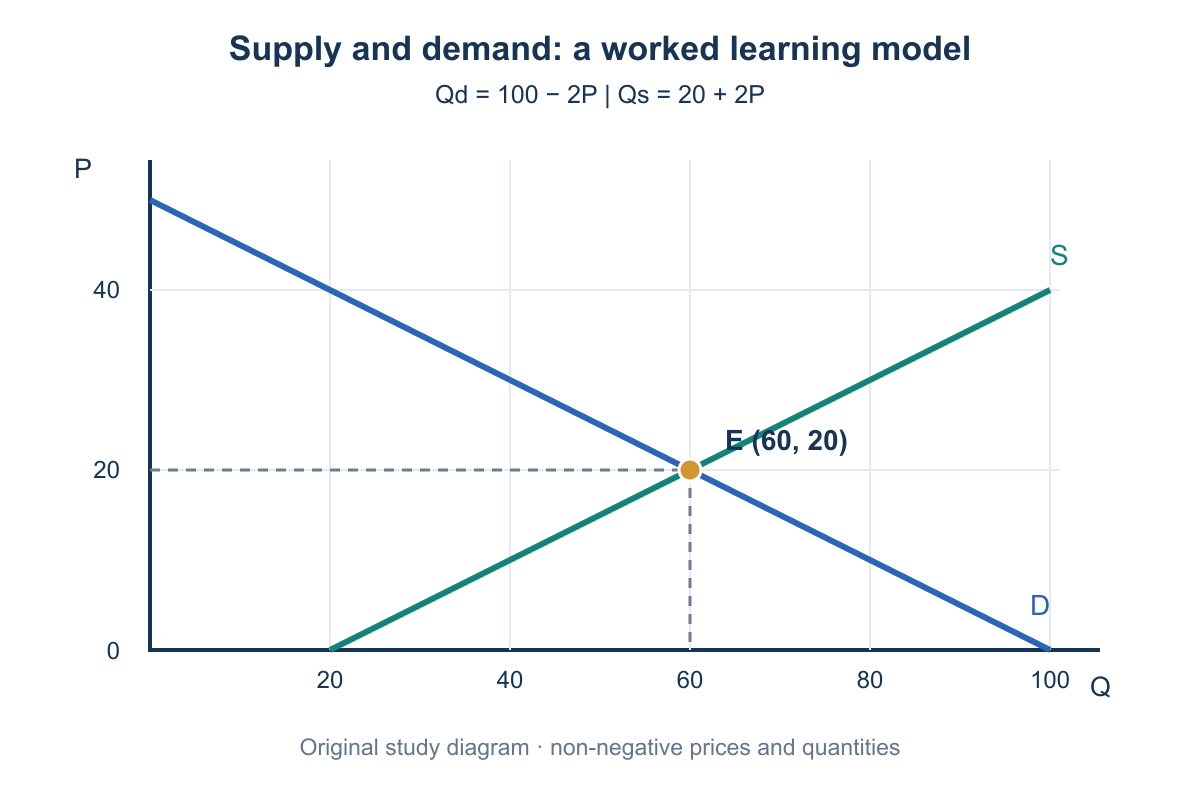
Original learning diagram: Qd = 100 − 2P; Qs = 20 + 2P
Now impose a price ceiling of 15, holding other conditions constant. Qd is 70 and Qs is 50, so quantity demanded exceeds quantity supplied by 20 units. State that the model predicts a shortage of 20 units at this price. Do not describe 70 as the quantity already traded or 15 as a new market-clearing price. How the available supply is allocated requires additional assumptions.
Use the exercise three times. First, work without a time limit and explain every symbol. Next, cover the calculation and check the direction using the diagram. Finally, change the ceiling to 25. Because it is above the equilibrium price, it is non-binding in this model; mechanically calculating another shortage would miss the point. Understanding a model means explaining when a conclusion holds and when it does not.
3. Identify conditions before relying on macroeconomic or financial formulas
Begin macroeconomics with a short news-style question: if the value of an economy’s output at current prices rises, can we immediately conclude that real output has increased? First identify the need to separate price changes from quantity changes, then study nominal measures, real measures and price indicators. This avoids interpreting every increase in money value as economic growth. When moving to aggregate demand and supply or monetary and fiscal policy, state the time horizon and model assumptions first.
In finance, attach units to calculations. Establish whether a rate is annual or monthly, whether a cash flow occurs at the beginning or end of a period, and whether the alternatives being compared have the same duration, risk and liquidity. A higher return alone does not establish that an option is more suitable. This is practice in recognising problem conditions, rather than a basis for making real investment decisions.
After learning a concept, construct a counterexample. High income does not necessarily mean more cash available at a particular moment, and higher business revenue does not guarantee higher profit. Identify the missing cost, timing issue or constraint instead of merely writing that it depends. Finding the omitted condition shows more understanding than remembering the vocabulary.
4. Start English explanations with three short sentences
Vocabulary notes should contain more than translations. Connect equilibrium to the equality of supply and demand, and shortage to quantity demanded exceeding quantity supplied at the same price. Add an explanation in your own words. Select a few useful terms at a time and test them in a problem a day later, rather than building a long list that remains difficult to recognise in context.
For the price-ceiling example, begin with The price ceiling is below the equilibrium price. Continue with At this price, quantity demanded is 70 and quantity supplied is 50. Finish with The resulting shortage is 20 units. The sentences establish the condition, calculation and conclusion. During practice, also state the assumption that other conditions remain unchanged.
When correcting an English response, check the economic relationship first, terminology second and grammar last. Replacing a short sentence with a long one does not automatically improve the argument. If you can only repeat the conclusion, point to the step in the graph that explains it. If you can explain it in Chinese but struggle in English, keep a short sentence structure and gradually remove the prompts.
5. Test a manageable routine over four weeks
The following personal starting plan uses three 60-minute sessions each week. Its purpose is to establish a routine and diagnose gaps; it does not imply that four weeks covers the syllabus or produces qualifying performance. During school exam periods, reduce new material while retaining one independent reattempt. If sessions repeatedly overrun, reduce the number of questions before cutting explanation and checking.
| Week | Focus across three sessions | Work to keep |
|---|---|---|
| 1 | Diagnose; study supply and demand; reattempt | A fully labelled graph and an explanation |
| 2 | Study price controls; nominal versus real; correct errors | A comparison of conditions and conclusions |
| 3 | Identify financial conditions; short English responses; reattempt | A solution with units, periods and assumptions |
| 4 | Mix topics; fill gaps; review earlier work | Priorities for the next stage of study |
At the end of each week, sort topics into those you can explain independently, those requiring prompts and those still unfamiliar. Give prompted work early attention because it is often closer to independent completion, while reserving regular time for unfamiliar areas. Avoid practising only the microeconomics questions you already enjoy. Judge progress by whether prompts become less necessary, rather than by question totals alone.
6. Connect the routine to the 2027 rounds
The 2027 first round contains 40 multiple-choice questions in 60 minutes, on 13 March 2027, 8–9 p.m. U.S. Eastern Time, corresponding to 14 March, 9–10 a.m. Beijing time. Round 2 requires reasoning in open responses and lasts 120 minutes, on 27 March, 8–10 p.m. U.S. Eastern Time, corresponding to 28 March, 8–10 a.m. Beijing time. The two dates fall on opposite sides of the U.S. daylight-saving change, so their time differences are not identical.
Dividing the first-round duration by the question count gives 90 seconds per question, but this is an overall average rather than a limit for each problem. After learning the concepts, use short sets to record time spent reading, calculating and checking. Mark lengthy questions and practise returning to unfinished work. Retain written reasoning throughout preparation for Round 2, so speed on multiple-choice questions does not conceal difficulty explaining an answer.
In 2027, both rounds are digital and may be taken at locations such as home, school or a library; each round must be proctored using the required technology. Registration closes 27 February 2027 at 11:59 p.m. U.S. Eastern Time, or 28 February at 12:59 p.m. Beijing time. Being a beginner describes a learning starting point, rather than entry eligibility. Before registering, distinguish eligibility to enter USAEBO from eligibility for Team USA.
7. Choose the next task using three observable actions
Before increasing question volume, choose a problem whose solution you have not just read. Check whether you can identify the decisive conditions, select a suitable model and explain the result in complete sentences. When all three are independent, gradually shorten the time. If model selection is still guesswork, repairing the concept is more useful than repeatedly recognising familiar answers.
When discussing study needs with a teacher or adviser, bring your grade level, courses studied, weekly available time and an independent attempt with working preserved. These details reveal whether English reading, economic modelling or open-response writing needs attention first. They also make the next plan depend on learning that can be checked, rather than only on a hoped-for award.
USAEBO study materials preview
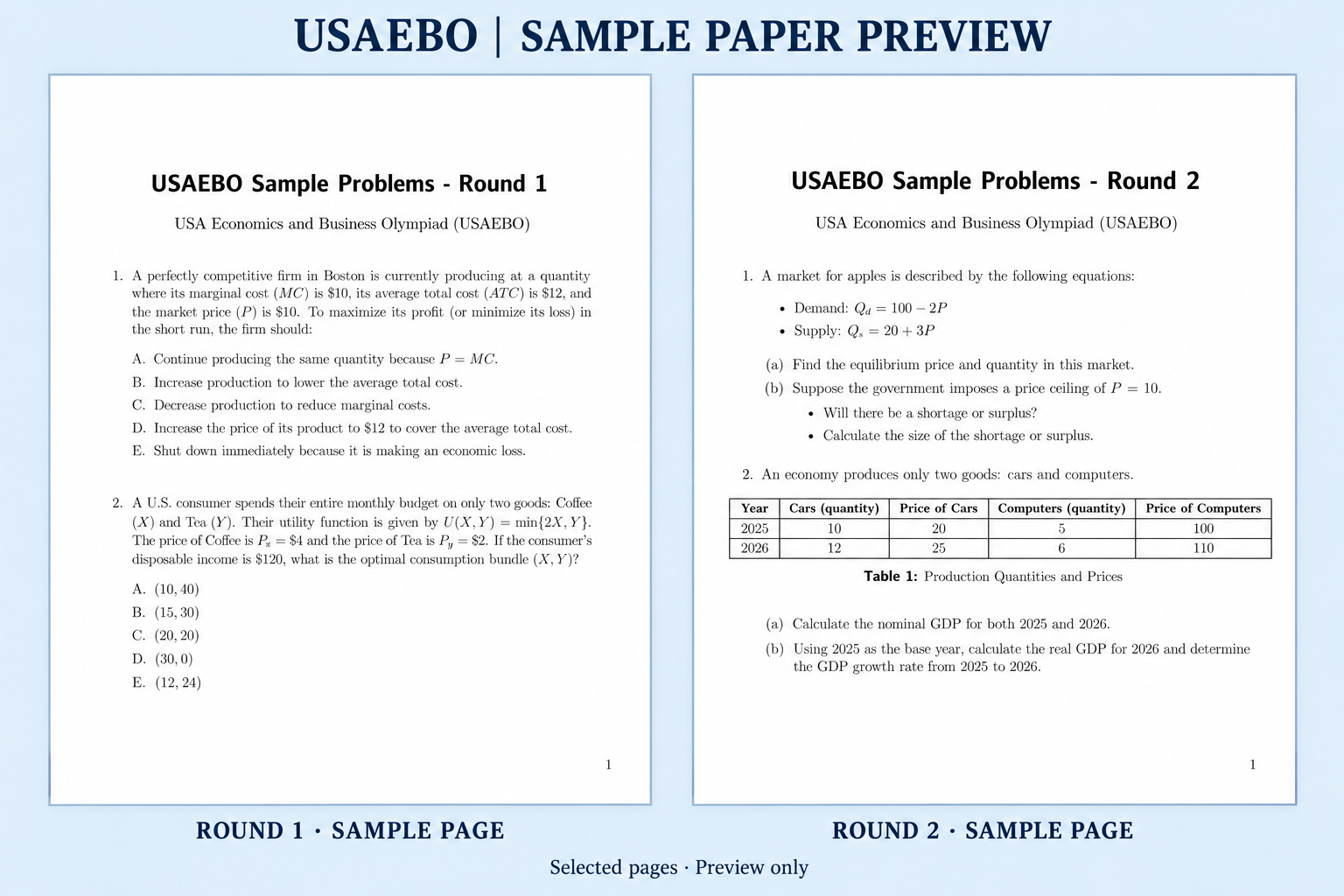
View both sample-paper pages in one image. Click to enlarge.
USAEBO Round 1 & Round 2 sample paper preview
The left panel shows page 1 of the Round 1 sample; the right panel shows the Round 2 sample page. Neither includes answers or worked solutions. The Round 2 sample uses Qs = 20 + 3P, whereas the original exercise in this article uses 20 + 2P. Set up the equilibrium equation from the conditions of the problem being attempted rather than reusing the article’s numerical results.
Scan with WeChat to discuss USAEBO preparation and study resources