
USAEBO papers and resources
Start with the official samples, then plan practice by topic. Explore paper previews, historical handbooks and IEO extension resources in one place.
Try the official samples
Read online or download directly; no adviser contact needed.
2027 format: 40 questions · 60 minutes
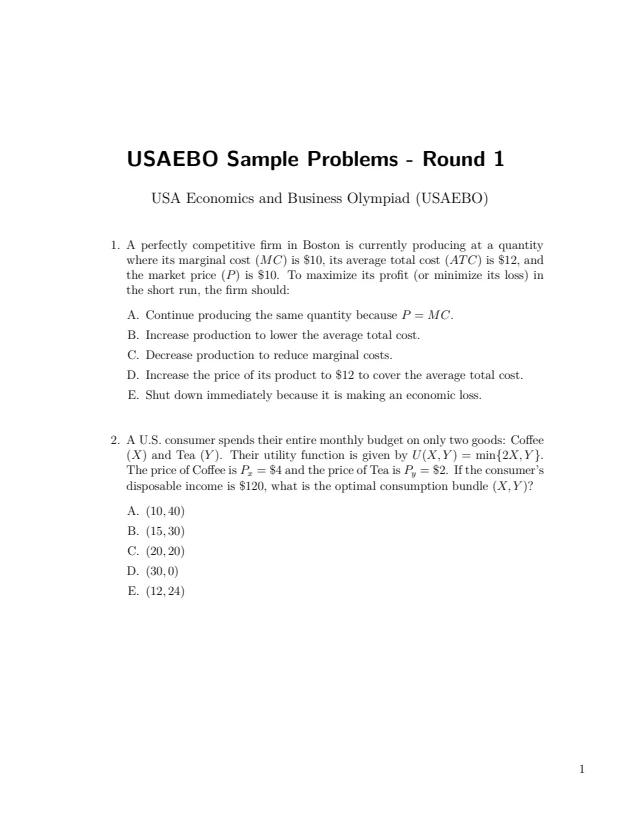
Official Round 1 samples
4 multiple-choice samples to introduce English question wording and calculations.
Practice focus: perfect competition, complements, interest-rate equations and NPV.
2027 format: 120 minutes · question count not specified
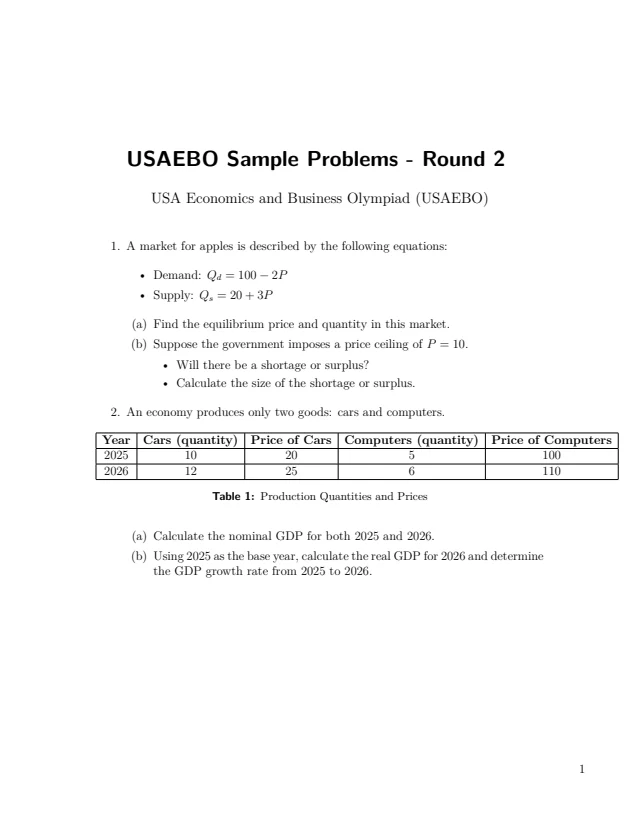
Official Round 2 samples
2 open-response samples for practicing step-by-step calculations and explanations.
Practice focus: market equilibrium, price ceilings, nominal and real GDP.
What to practice after the samples
Use unfamiliar concepts to choose your next practice questions.
- Attempt the samples
Note unfamiliar concepts, calculations and English wording before reviewing your work.
- Review by topic
Use the index and syllabus to focus on concepts you cannot yet explain clearly.
- Check with past papers
Practice decisions and calculations in Round 1; show assumptions, reasoning and conclusions in Round 2.
View the 2026 past-paper topic index
Round 1 · 25 multiple-choice questions
- Q1–3Opportunity cost, comparative advantage, demand elasticitypp. 1
- Q4–12Revenue maximization, taxes, costs, monopoly, Nash equilibrium, externalitiespp. 2–5
- Q13–21GDP, inflation, employment, multipliers, AD-AS, output gaps, Phillips curve, loanable fundspp. 5–8
- Q22–25Profit maximization, revenue/cost graphs, NPV, elasticitypp. 9–10
Round 2 · 7 problems, 20 points each
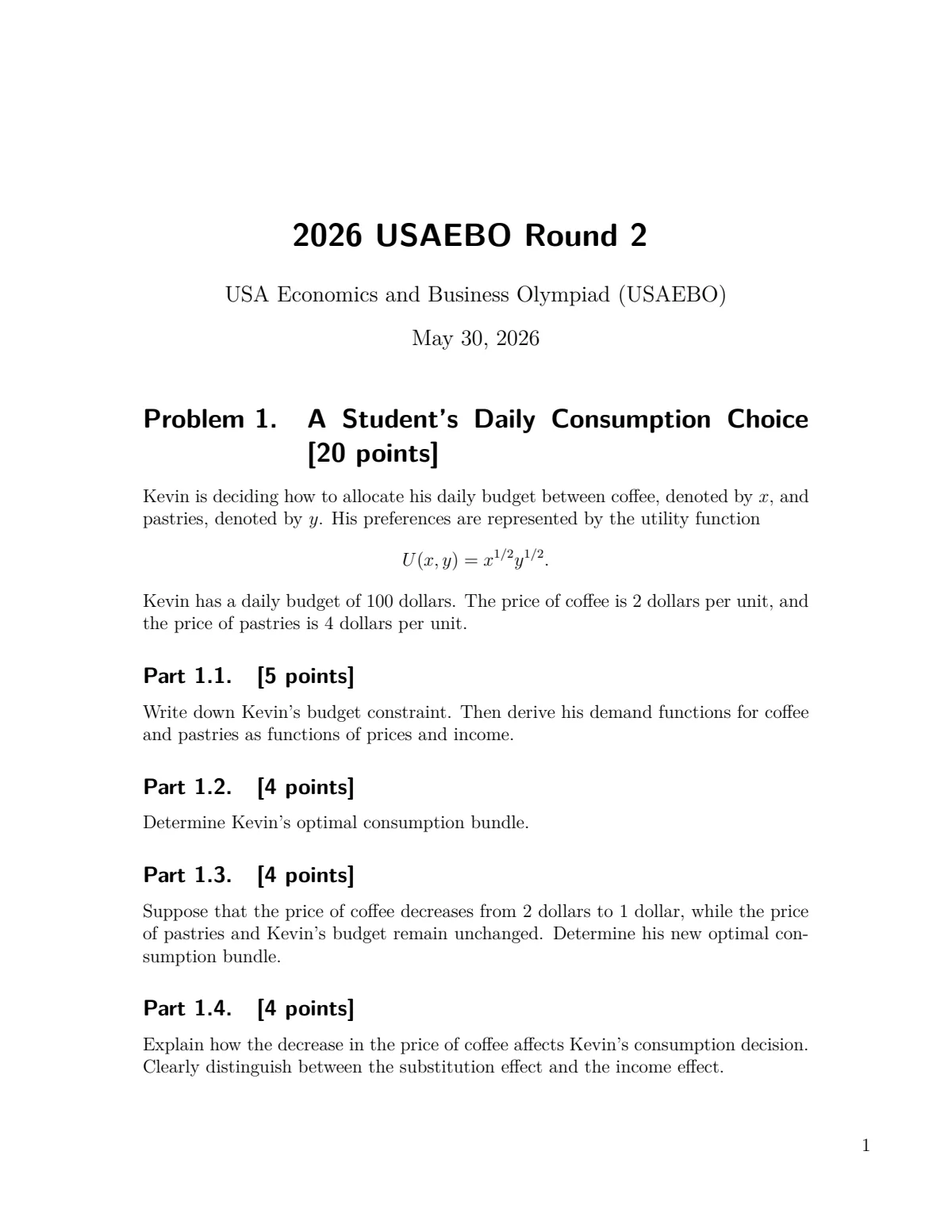
- P1Consumer choice: budget constraints, demand and income effectspp. 1–2
- P2Duopoly: best responses, Nash equilibrium and collusionpp. 3
- P3Fiscal stimulus: spending multipliers, interest rates and crowding outpp. 4
- P4Pollution and externalities: social efficiency, taxes and quotaspp. 5
- P5Intertemporal choice: saving, interest rates and time preferencespp. 6
- P6Labor-market signaling: separating, pooling and incentive compatibilitypp. 7–8
- P7Corporate finance: risk sharing, expected utility and moral hazardpp. 9–10
Use this index to address gaps, rather than to predict future questions. Attempt the problems independently before returning to the syllabus. View the full syllabus
2026 papers: preview before requesting
Two original papers, 20 pages; request the complete bundle if useful.
The two papers work with the topic index on this page to help organize concept, calculation and open-response practice.
View the paper list and previews
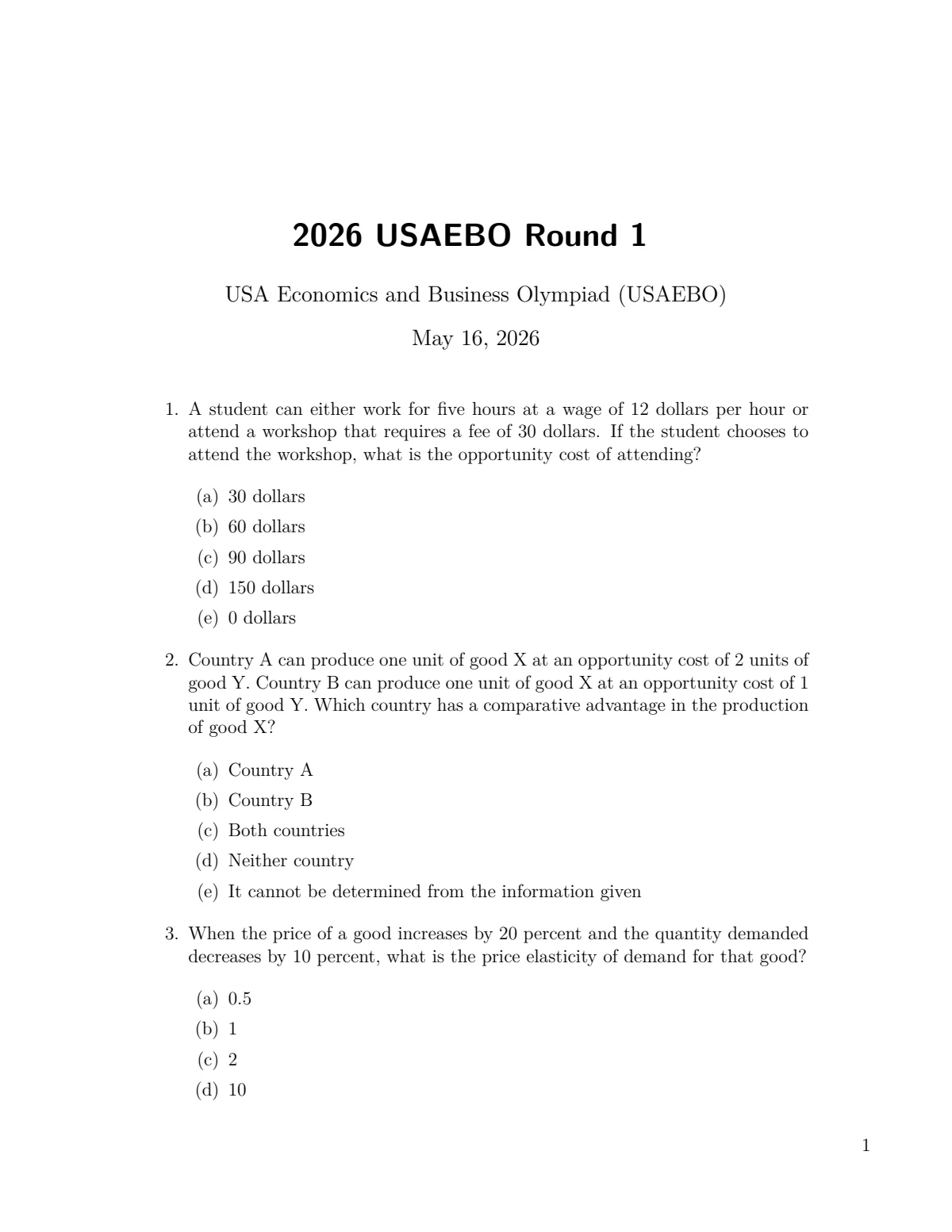
2026 Round 1 paper
25 multiple-choice questions for concept, calculation and graph practice.
Use it to check concepts, calculations and graphs; its length differs from the 2027 format.
Preview page 1 of 10
2026 Round 2 paper
7 open-response problems, 20 points each and 140 points in total; reasoning is required.
Use it to practice model assumptions, step-by-step derivations and explanations in English.
Preview page 1 of 10
Contact the adviser on WeChat and send “USAEBO papers” to request the files.
Request the paper bundle on WeChatHistorical handbooks and procedures
For students exploring how the previous exams were organized.
Historical reference for 2026 only. Equipment, OBS, LateranAI, permitted materials and submission rules do not establish the 2027 requirements. Follow the handbook and participant notices for the relevant season.
View the handbook list (3 PDFs) and historical records
Additional historical records
Read the 2026 procedure reference
Everything below comes from the 2026 materials and does not establish the equipment or submission arrangements for 2027.
- Equipment and preparation
- The 2026 handbooks required one computer and setup 30 minutes before the exam. Blank paper, pens or pencils and non-programmable calculators were permitted; additional monitors were prohibited. Listed accessory exceptions included a mouse, keyboard, power supply, adapters and external drives.
- OBS recordings and technical proctoring
- The 2026 handbooks required OBS to record the entire screen, including the taskbar, together with two camera views showing the contestant’s face and surroundings. Recording began 10 minutes before the exam, and contestants were required to remain at their desks. LateranAI was a separate requirement and did not replace the required camera recordings.
- Round 1 submission
- In 2026, the answer form had to be submitted before the exam deadline; the handbook recommended reserving at least five minutes. The supplementary form, including recording links and scanned scratch paper, was due within 24 hours after the exam.
- Round 2 handwriting and partial credit
- The 2026 rules required handwritten responses on blank paper, with the contestant’s name, school, problem number and page number on each sheet. Subparts had to be labeled, final answers boxed and handwriting legible for scanning. Well-reasoned work could receive partial credit even when the final answer was incorrect.
- Round 2 scanning and uploading
- In 2026, the 30 minutes after the exam were for scanning and submission only, with no further solving permitted. Each problem required a separate file, combining all pages for that problem. Recording continued through scanning, uploading and submission; the supplementary form was due within 24 hours.
- Scratch-paper retention and LateranAI
- The 2026 handbooks required scratch paper to be retained for 14 days. The accompanying LateranAI file lists Windows 11 and macOS 15; credentials and the software download were supplied through a personal email. These are historical instructions, and 2027 requirements need separate confirmation.
Contact the adviser on WeChat and send “USAEBO handbooks” to request the files.
Request the handbook bundle on WeChatIEO extension: explore further when ready
6 PDFs: tasks, corresponding answers, syllabus and business case.
Keep the two competitions distinct
USAEBO is a two-round individual competition that selects eligible students to represent the United States at IEO. IEO has its own syllabus, scoring rules and team business case. The answers below apply only to IEO papers and do not establish USAEBO answers or its exam format.
View the IEO resource list (6 PDFs · 83 pages)
Multiple choice: attempt, then check
The answer version marks correct choices in red; it does not provide worked derivations.
Open questions: review reasoning and marking
Attempt the original questions before reviewing the solutions and marking schemes.
Syllabus and team business case
The scope of the further reading
IEO recommends the microeconomics and macroeconomics parts of CORE Econ’s The Economy 2.0, with Mankiw’s Principles of Economics as a supplement. Finance resources include GFLEC, FDIC Money Smart, PwC personal finance lessons and Khan Academy. These are IEO recommendations, not an official USAEBO textbook list.
Contact the adviser on WeChat and send “IEO resources” to request the files.
Request the IEO bundle on WeChatQuestions about these resources
What can I use directly, and how do I request full files?
Both official sample sets can be read and downloaded directly. The practice guide, topic index and first-page previews of both 2026 papers are also available here. For complete files, choose a bundle, contact the adviser on WeChat and send its name; the adviser provides the files. Requesting resources does not register you for the competition.
Should I start with samples or past papers?
Start with the samples to learn the question styles: four multiple-choice questions for Round 1 and two open-response problems for Round 2. Then attempt the 2026 papers: 25 multiple-choice questions in Round 1 and seven open-response problems worth 20 points each in Round 2. Samples provide an introduction; past papers support a broader check of your knowledge.
Do the USAEBO files include official answers?
The two USAEBO past papers and two sample sets on this page do not include answer keys or worked solutions. A separate publicly available official USAEBO answer file has not been located. Answers in the IEO section apply only to the IEO papers and cannot be used to check USAEBO responses.
Can I use the 2026 papers as full 2027 mocks?
Use them to practice economic concepts, graphs, calculations and reasoning in English. They are not full mocks for the 2027 format. Round 1 in 2027 has 40 questions in 60 minutes; Round 2 is open response with 120 minutes, and the announcement reviewed does not specify its question count. Both rounds use technical proctoring. Read the schedule page on this site for the season’s requirements.
Do the historical equipment and submission rules still apply?
The 2026 handbooks and LateranAI instructions explain the procedures used that year. Requirements for OBS recordings, supported systems, permitted materials and submission windows do not automatically carry over to 2027. Prepare using the handbook and participant notices for the relevant season.
How should I choose what to study next?
Attempt the samples independently and note unfamiliar concepts. Use the index to find related past questions, then return to the syllabus to address gaps. For Round 2, also practice explanations in English, model assumptions and step-by-step derivations.